| ||||
Child Safety | Criminal Mindset | Knife Fighting | Legal | LEO-Military-Security | Martial Arts | Property Crime |
Psychological | Rape | Robbery | Self-Defense | SD, DT, WSD Training | Stalking-Domestic Violence | Street Fighting
Search NNSD
Donate to NNSD
Marc MacYoung?
Dianna Gordon MacYoung?
Animal E-list
Crime Avoidance Lectures
Crime Blog
Colorado Classes
Contact Us
FAQs
Hosting A Seminar
Crime Prevention
Expert Witness
Knife Defense
Law Enforcement
Martial Arts
Military
Movie Consulting
Women's Self-Defense
Links
Our Linking Policy
On-line Store
Train with MacYoung
Testimonials
Terms of Use
Topics of Interest

Legal Aid/Training
for self-defense &
firearm use

Chokes and Sleeper Holds
Alain Burrese
DVD
(SD, MA, street)
MA, SD and a whole lot more
Best of Wim's blog Vol I
DeMeere
Infighting
Rory Miller
DVD
(Close quarter violence)
Arm Locks for All Styles
Iain Abernethy
(Non-striking control)
Fighting in the Clinch
Loren Christensen
(SD, cop, street)
Chiron Training Vol: I
Rory Miller
(Blogging on violence, etc)
How to Box
Terry McGovern
(Boxing, technical)
In the Name of Self-Defense
Marc MacYoung
(Violence, crime & aftermath)
Read AFTER "What You Don'tKnow..."
I will not take through sacrifice what I can
more easily achieve through strategy.
Gen. Douglas MacArthur
Angles In Martial Arts and Defensive Tactics
There is a reason that the old cliche about the young fighter going down to defeat at the hands of the old master exists. As anyone who has experienced the helpless feeling of being effortlessly thrown around by a little old 'master' can tell you, it's true! It's as though every strength you rely on has magically vanished and the only thing between you and major pain is the master's self-control.
Simply stated, the older, more experienced fighter is using his brains rather than brawn. Often it only looks like he's coming straight in. He's not. Also, the older person is a master of effective movement. That is to say: He is accomplishing more using less. The reason he can do so is based on two important concepts. 1) Although he is using less force, he is applying it where it will do the most good. 2) Instead of overwhelming his opponent's ability to resist, he is undermining it
Angles are integral to doing this. They are exactly what an older, slower, creakier person (or smaller) can use, with very little physical exertion, to easily defeat a younger, faster, stronger and bigger opponent. And do so without getting torn up in the process (Important because as you get older, you heal slower).
Angles allow a smaller, weaker person to defeat a larger, stronger, charging opponent. This is because the person using angles is not contesting the larger person's advantages. It's rendering those advantages meaningless. It isn't just refusing to play the larger person's game, it's taking away those advantages.
Imagine trying to play American Football against a fully equipped professional on a football field. You'd lose, right? With his size, speed and skill, he'd just run over you.
What we are talking about by using angles is still playing football, but akin to putting the professional player in roller skates and on ice.
It doesn't matter how big, strong and aggressive he is. By creating those conditions, you render his superior size and strength useless. That's because you've destroyed the foundation upon which they are based (No traction or balance on ice and roller skates). Without this 'base' he cannot effectively attack you using size, strength or bad attitude. You, on the other hand, are wearing ice skates and easily skating over the goal line. That's how much more effective angles are over head-on aggression.
The price of this, however, is that you have to think.
Instead of giving into your emotions and blindly throwing
yourself against your opponent's greatest strengths (e.g. a head-long
charge), you have to keep your head. This is what will allow you to achieve
those two points the masters use to easily defeat younger, stronger and
larger opponents. You are literally faced a choice, blindly hit someone
blindly five or six times (and hope he retreats) or accurately hit him once
on an angle and
a) secure your defensive perimeter
b) disrupt his ability to attack you
c) set up your next offensive move
When you understand angles, you can accomplish three things with one move. If you maintain this ratio, you can accomplish in three moves what other people hope to achieve in nine moves -- but seldom do. That's because very seldom will your opponent stay still for you to complete nine moves. This is especially true if he is still capable of resisting up until your fourth move.
Researching how to render your opponent incapable of resisting before you find yourself in a situation requiring control and restraint techniques, will save you massive amounts of hard work, frustration, fear and -- most importantly -- injury. And by this we mean injury both to you and to the perp. When you try to overwhelm resistance there is a good chance of breaking that which is resisting (in this case the perp). You're less likely to break things if you undermine the perp's ability to resist.
The bottom-line is you are faced with a choice: fight harder or fight smarter.
Fighting smarter not only is easier, but it hurts less ... if you choose not to fight smarter, you will end up fighting harder. At best you're going to end up spitting blood. At worst ... well, let's just say that strategy only works until you meet up with someone bigger and stronger than you.
How Most People Fight
Unfortunately, many people think that fighting harder is the secret to
effective fighting. And why shouldn't they? That's an idea that has
been well marketed and advertised. You charge in head-long and overwhelm
an opponent. This attitude is further entrenched by much of the
marketing surrounding various
Mixed Martial Arts sporting events and
Adrenal Stress Training.
The simple truth is that the outcome of most conflicts is determined by size and strength. In a head-on-conflict, the larger, stronger and more physically fit participant usually wins the fight. They charge head-on, and the physics granted by their superior mass grants them victory -- especially against smaller and inexperienced opponents. When it comes down to that show, Damon Runyon was right when he said: The race is not always to the swift, nor the battle to the strong, but that's the way to bet.
So as long as you are limiting yourself to fighting smaller and weaker opponents, size and strength will usually carry the day for you. Sure, it's a lot of work, but if you're bigger and stronger, you can get away with working harder instead of smarter.
However, the option to pick and choose who you go up against isn't always there -- especially for police officers and other security professionals.
It is unwise for smaller, weaker and older officers to try to close with larger and stronger opponents using these same tactics. They simply do not have the mass to overwhelm a larger opponent's structure and balance. Not only doesn't it work as well for them if they are closing on a perp, but if they try to meet these same tactics head on, they will be overwhelmed. While we're on the subject, even big officers meet up with bigger perps now and then.
On top of all this, even if you are in good shape, you're still going to get knocked around if you charge straight in. Bumps, bruises, torn uniforms, scrapes, risk of blood born pathogens as well as paperwork and your face ending up on Youtube.com abusing the poor innocent 'victim' are all problems that result from fighting harder.
Introduction to Using Angles
In a physical conflict, a sure sign of someone using brains is that
he/she uses angles to quickly and effortlessly end the conflict. Not
only does this prevent the younger, stronger opponent from
effectively deploying his own strengths and advantages, but it
almost looks like he tripped/slipped/fell down. When someone is very
good, there is not a big flashy show of whirling fists and feet,
just a slight movement, a thud and the attacker is on the ground.
Well, that can take a few years of practice to get to that point.
Still, someone who is less good, can still use
angles. Look at the picture and notice that the
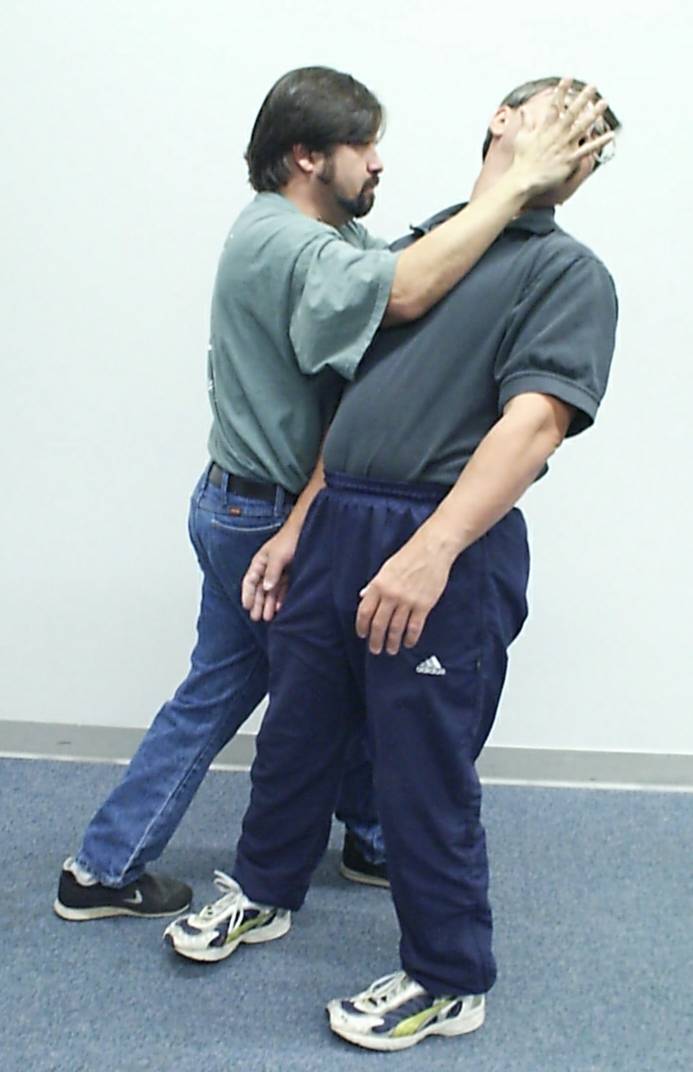 opponent has been manipulated into a odd-looking pose. This is not a
straight in attack, it is an example of using angles. What started
as a face-to-face position (which a high level of threat) has been
drastically changed with just a hand on the face and two diagonal
steps on the diagonal (step towards his shoulder with the left foot
and continue past his shoulder with the right foot). This is what we
refer to as a "crossroads position." From this position you have
several options; each option will create a different level of force.
If this were a quarrelsome drunk, the suspect could be gently spun
to the ground to land on his stomach and in a cuffing position. If
he were on the fight, he could be immediately dropped to the floor,
where he could be dogpiled or the officer could withdraw and safely
deploy a distance weapon. If the perp were offering the officer
lethal force, this position is -- literally -- one step away from
the application of enough force to stop the threat.
opponent has been manipulated into a odd-looking pose. This is not a
straight in attack, it is an example of using angles. What started
as a face-to-face position (which a high level of threat) has been
drastically changed with just a hand on the face and two diagonal
steps on the diagonal (step towards his shoulder with the left foot
and continue past his shoulder with the right foot). This is what we
refer to as a "crossroads position." From this position you have
several options; each option will create a different level of force.
If this were a quarrelsome drunk, the suspect could be gently spun
to the ground to land on his stomach and in a cuffing position. If
he were on the fight, he could be immediately dropped to the floor,
where he could be dogpiled or the officer could withdraw and safely
deploy a distance weapon. If the perp were offering the officer
lethal force, this position is -- literally -- one step away from
the application of enough force to stop the threat.
The development of this position could occur while deflecting an attack or a pre-emptive move (to control the situation). In either case, instead of the perp's next move being an attack, he must address the problems the officer created (e.g., a loss of balance, change of orientation and loss of vision). While the perp's next move would be to regroup before attacking/resisting, the officer's next move ends the situation. While the perp is trying to get it back together in order to resist, the officer is ending it.
Here is a bit of shocking news for panic junkies (those who insist that any and all technique fails under stress). If you can stick your hand out and step you can do this move -- even in a crisis. The really good news is that you can learn how to reliably create these conditions with a few hours of qualified instruction and a day of practice.
By moving in certain ways and holding his/her body in particular poses, a person using angles delivers force so that the opponent is physically incapable of resisting. And the reason the attacker cannot resist is not because he is being forced against how his body works, but because the smaller person is moving him in ways that his body does move.
It's hard to force someone against how his body works., but it is easy to move someone the way their body is designed to move. An easy way to understand what we are talking about is to think of hijacking. When someone hijacks a shipment, they don't turn the vehicle off and unload it there do they? No, they get in and drive/fly the vehicle somewhere else. Nor do they stop, tear out the engine and steering mechanisms and install their own. They use the vehicle's existing systems to move it elsewhere.
In effect, the officer is hijacking the perp. The officer is controlling how the perp moves! The officer is turning the perp's own body against him and putting him where the officer wants him.
Sound complicated? It is and it isn't. You don't have to know how to design and manufacture a car in order to drive one do you? Same thing, you don't need to be a physiologist to be able to move someone's body. But we do need to give you some basic concepts so you know why these things work.
Our bodies are designed to both resist and
generate force in certain ways. But, in order for you to move,
your body must be flexible in other ways. (If this wasn't the
case, then you'd move like Frankenstien's monster.) While we can
resist force very well along the same lines that we can generate it,
we're pretty weak at resisting force along our routes of movement.
We simply are not designed to resist being moved along these
ways. Yes, we can muster some resistance, but that resistance can
easily be overcome. And with a LOT less force than trying to move us
in ways
a) we aren't supposed to move or
b) against the lines that we can generate force along.
A good example is that it is much easier to spin
someone than it is to push them backwards -- especially if they are
trying to push forward. This moves him into a very unstable pose
that you can exploit. All it takes is a push on one shoulder and a
pull on the other. That creates a rotation around his own body's
vertical axis. Also by spinning him, you redirect his movement away
from you. This is especially important if the person is larger than
you. By redirecting his body, you redirect his force.
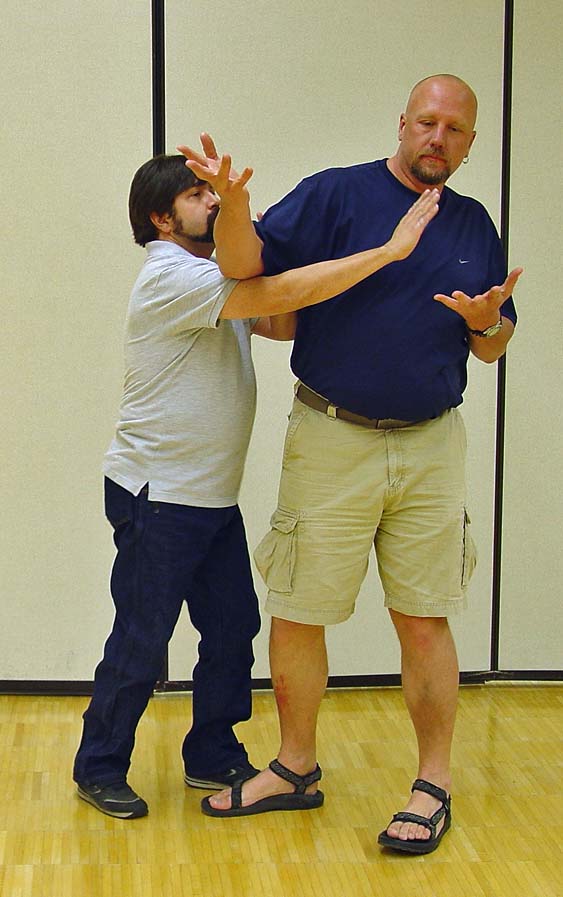
Pay close attention to what we just said there. We are not necessarily talking about taking control of his movement (although that does result) what we are talking about is taking control of how his body moves.
A lot of people have a hard time understanding how to turn someone's movement against them, but once you understand how the human body moves, you can take control over it in all kinds of circumstances. But that's because you're not trying to catch up with his movement, you're catching him and moving him where and how you want him. (1)
So, here are two basic rules of what angles are
and how to use them. If anything else we say on this page confuses
you, just return to these two basic ideas:
1) Moving your opponent in a way that his body normally moves --
until things go wrong for him
2) Applying force into your opponent that traps him between another
force and/or condition.
Now the second sounds a whole lot more complicated than it is. Let us explain why by asking you some questions. Don't worry, we'll also give you the answers.
First, which way does gravity go? (The answer is "Down."). So what happens if you hit upwards into his body? (The answer is "His body is trapped between two opposing forces." He can't escape and that hurts a whole lot more.) What's underneath his feet? (The answer is "The Ground.") Which one is going to withstand the force of getting struck, him or the Earth? (Hint, 3rd Rock from the Sun.) What is going to give when you strike downward, pinning him between the force of your blow and the earth? (Answer: Him -- more specifically those parts of him that are designed to flex.)
If you just hit straight in (parallel to the floor) on a stationary person there is no opposing force/condition. Usually what happens is that the person will simply stagger back and regain his feet. So your "hit" has become a "push." If, on the other hand, you do the same against a charging person, his mass and momentum will often overwhelm the force of your strike and he keeps on coming. But, if you hit either up or down you will get much better results. That's because ALL of your force is going into his body. There is no way for him to bleed it off or shed it. (Oh, BTW, if he's charging, you might want to move out of the way as you do this. Otherwise it's like standing in front of a crashing airplane. If he's standing there being a passive resister, keep on moving in and move him where you want him to be.)
In a nutshell, that's what angles are. It's remembering not to try to move straight in, but 1) to move him in ways his body can't resist (until something bad happens) and 2) trapping him between your force and something else.
You will be amazed at the amount of bang for your buck you will get out of doing either of these two things (better if you do both). This is pretty much the "why" of little old, small martial arts masters throwing around big burly younger students. (Well, that and location). And this exact trick of turning a perp's body against him works just as well for officers.

What You Don't Know Can Kill You
MacYoung/Meek
(How your SD training will put you into prison or the ground)
Fighting Arts of Indonesia
Bob Orlando
(Martial Arts, Kun Tao, Silat)
Karate's Grappling Methods
Iain Abernethy
(Clinching and throwing)
Restraint, Control and Come Along Techniques
Alain Burrese
DVD
(Professional use of force)
Savage Science of Street Fighting
Ned Beaumont
(Street, SD)
Combat Sanshou
Vol 3 Take down/throws
Wim DeMeere
DVD
(MA, self-defense, cops)
Training For Sudden Violence
Rory Miller
(Training drills/physical)
Fighter's Fact Book
Loren Christensen
(Violence, training mental preparation)
Timing in the fighting arts
Christensen L/DeMeere W
(Speed and timing)
Effortless Combat Throws
Tim Cartmell
(MA, SD, law enforcement)
Surviving Armed Assaults
Kane /Wilder
(SD, MA, street survival)
Training Sudden Violence
Rory Miller
DVD
(Training drills/physical)
Writing Violence
Vol: IV Defense
Marc MacYoung
e-book
(Defensive action and failure)
| About navigating this site | Animal List | Bibliography | Bullies | Burglary while on vacation | Classes in Colorado | Car Jacking | Children and Martial Arts | Child Safety | Criminal Mindset | Cults in MA/SD | De-Escalation | E-mail Dianna | E-mail Marc| FAQs | Have MacYoung speak about crime avoidance | Home Page | Home Defense | Hosting a Seminar | Fear | Five Stages of Crime | Knife Fighting | Legal Issues | LEO/Correctional Officer/EMS | Linking policy | Links | Martial Arts | Photo Gallery | Property Crime | Psychology | Rape | Robbery | Safe Dating | Self-Defense Training | Selling your books/DVDs on NNSD | Seminar Schedule | Stalking/Domestic Violence | Street Fighting | Terms of Use | Testimonials | Train with Marc MacYoung | Who is Dianna Gordon MacYoung? | Who is Marc "Animal" MacYoung? | Victimhood | Workplace Problems | Zero Tolerance | ||
| ? 1998-2019 No Nonsense Self-Defense, LLC. All rights reserved. |


